AI Integration Use Cases
Here is an overview of typical use cases where the Naftiko Fleet helps developers and platform teams deliver Spec-Driven Integration end-to-end — from authoring with Crafter, validating with Polychro, running with Ikanos, governing with Warden, and orchestrating across the estate with Skipper. Additional capabilities are being added as described in the Fleet roadmap, with component-level detail in the Ikanos roadmap and Polychro roadmap.
1. AI integration
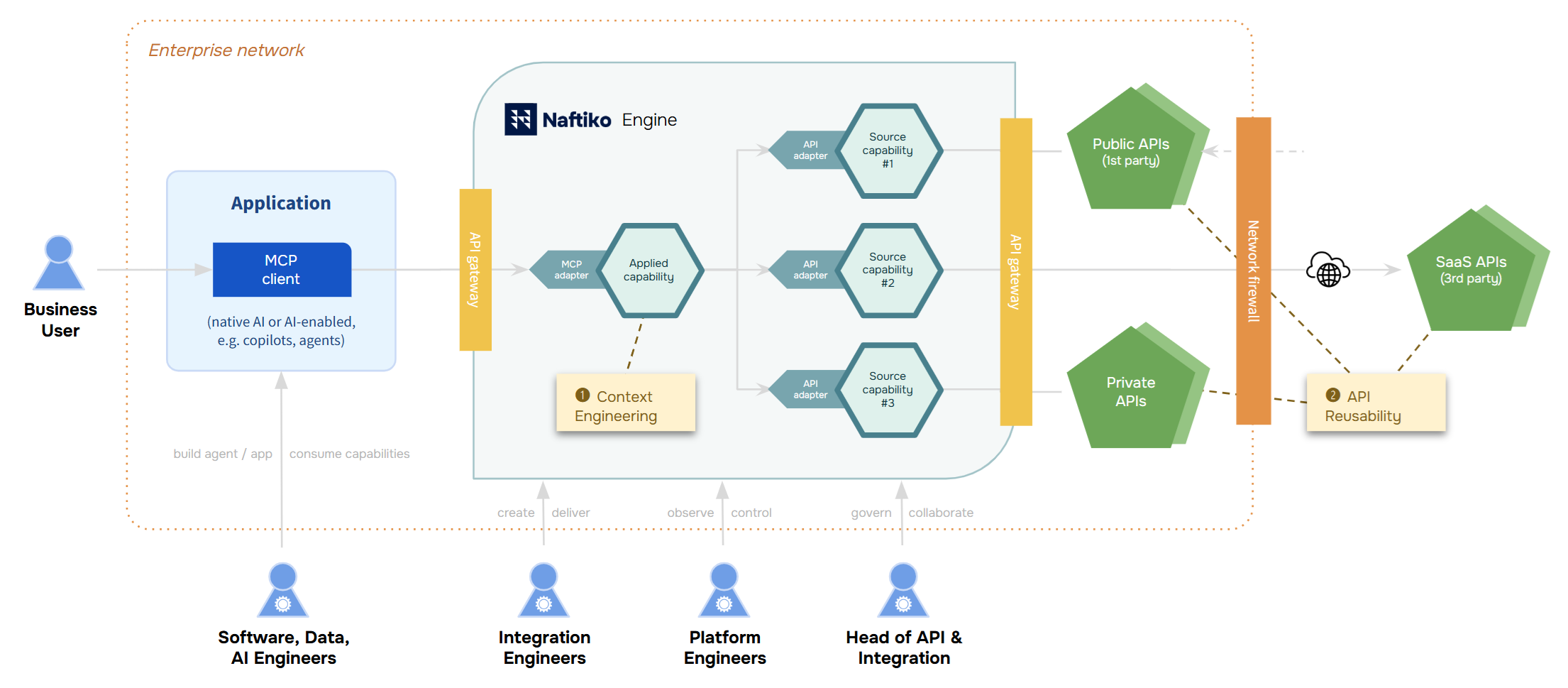
Connect AI assistants to your systems through capabilities, so they can access trusted business data and actions without custom glue code.
How the Naftiko Fleet achieves this technically:
- Declare upstream systems in capability.consumes (typically type: http) with namespace, baseUri, authentication, headers, and operation contracts — authored with Crafter and validated by Polychro.
- Expose the same domain as type: mcp tools and/or type: api resources in capability.exposes, served at runtime by the Ikanos engine, so both AI agents and traditional clients use one integration layer.
- Use call, with, steps, and JSONPath mapping in outputParameters to return normalized, task-ready payloads instead of raw provider responses.
Key features
- Declarative HTTP consumption with namespace-scoped adapters
- Bearer, API key, basic, and digest authentication
- Templated baseUri and path parameters
- Polyglot exposure from one capability
- Agent skills exposure for AI agents
- MCP tool exposure for AI agents
- REST resource exposure for conventional clients
- Output shaping with typed parameters and JSONPath mapping
- Nested object and array output parameters
- Static values for computed fields
- Externalized secrets via
binds(file, vault, environment)
2. Rightsize AI context
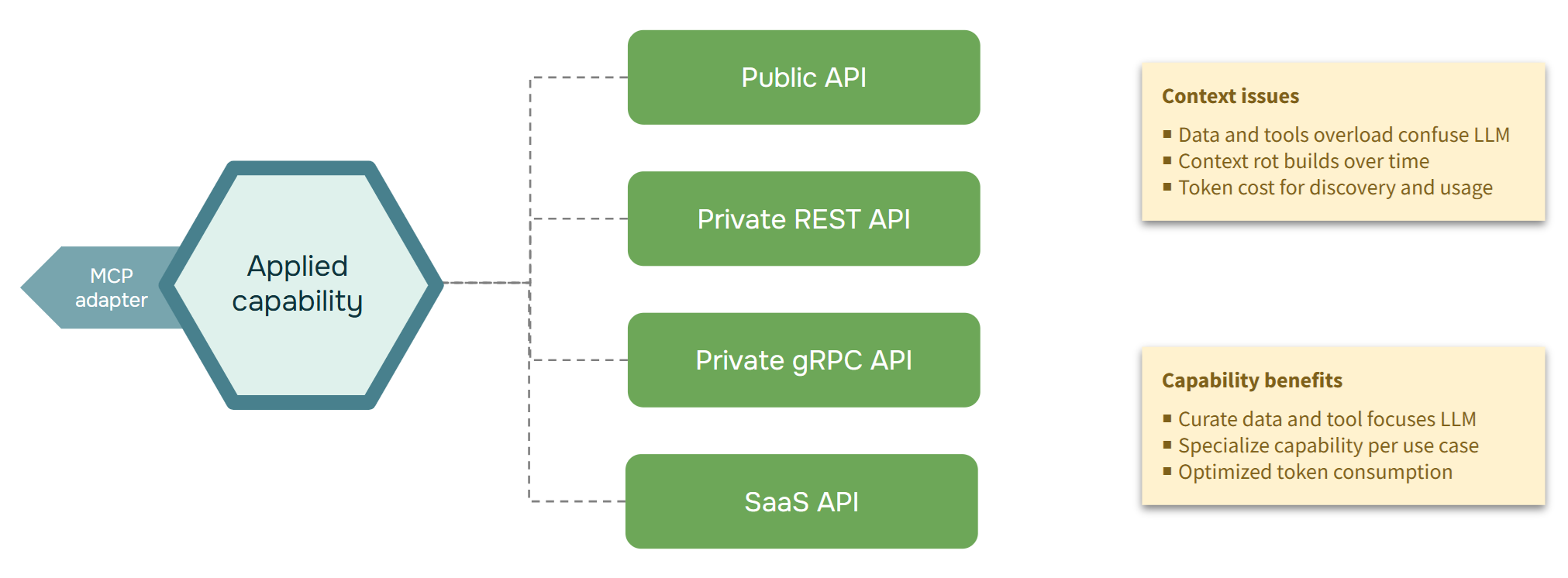
Expose only the context an AI task needs, reducing noise, improving relevance, and keeping prompts efficient.
How the Naftiko Fleet achieves this technically:
- Shape response payloads with typed outputParameters (string, object, array) and fine-grained JSONPath mapping expressions, executed by the Ikanos runtime.
- Keep only relevant fields in exposed tool/resource schemas, while hiding irrelevant upstream fields from the AI surface — enforced through Polychro rulesets in CI.
- Attach meaningful info.description, tool descriptions, and tags so discovery is semantic and context quality stays high.
Key features
- Declarative applied capability exposing MCP
- Declarative applied capabilities with reused source capabilities
- Support for key MCP transport protocols
- MCP for Streaming HTTP (for remote MCP clients)
- MCP for Standard IO (for local MCP clients)
- Output shaping with typed parameters and JSONPath mapping
- Fine-grained field selection and nested object mapping
- Static values to inject context
- Typed MCP tool input parameters with descriptions
- Required/optional parameter declarations for agent discovery
3. Elevate an existing API
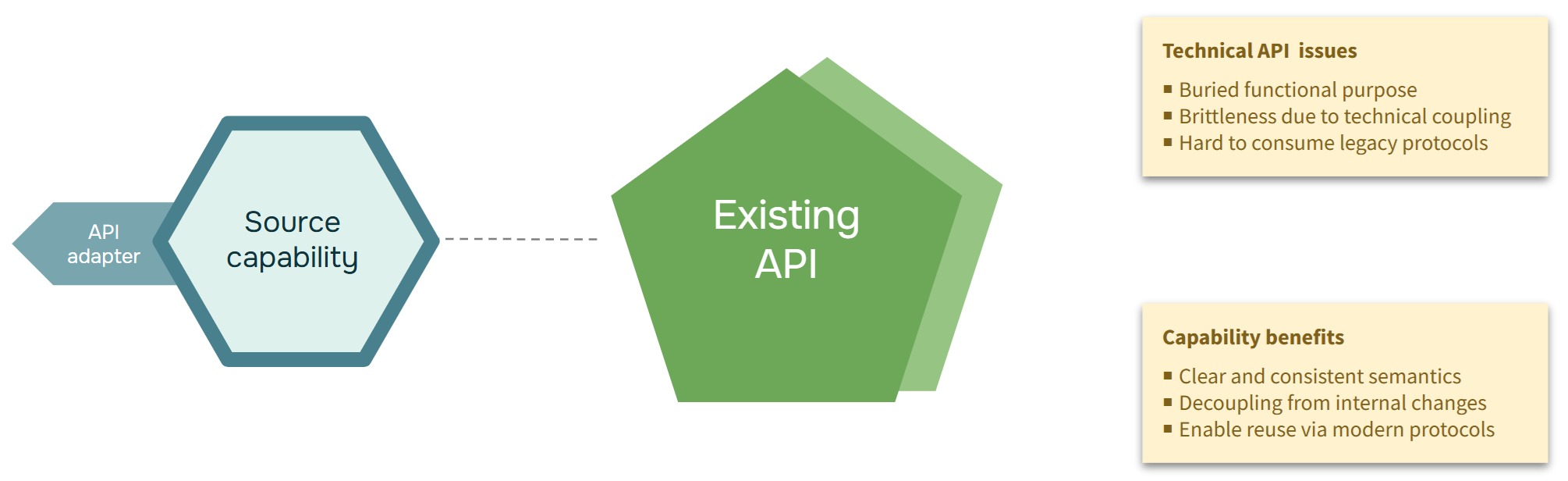
Wrap a current API as a capability to make it easier to discover, reuse, and consume across teams and channels.
How the Naftiko Fleet achieves this technically:
- Model the legacy/existing API once in consumes.resources.operations with explicit methods, paths, parameters, and body formats.
- Add a stable capability namespace and expose curated resource paths/tools that are easier to consume than vendor-native endpoints — surfaced by the Ikanos engine.
- Reshape not just data but also operation semantics: declare semantics (safe, idempotent, cacheable) on aggregate flows so the engine derives correct HTTP methods for REST adapters and hints for MCP tools automatically.
- Enforce schema-based validation (capability-schema.json) with Polychro so the elevated contract remains consistent and machine-checkable.
Key features
- Pass thru source capability
- One source HTTP adapter per capability
- Multiple source HTTP adapters per capability
- Declarative source HTTP adapter and target REST adapter
- Focus on source APIs with JSON payloads
- Change HTTP methods to expose proper semantics
- E.g. Adapt read-only POST queries into cacheable GET queries
- Reshape operation semantics via
aggregates- Declare safe, idempotent, cacheable on domain functions
- Engine derives REST methods and MCP tool
hintsautomatically
- Convert XML, Avro, CSV, TSV, PSV, HTML, Markdown payloads to JSON
- Schema-based validation with Spectral rules
- Namespace uniqueness, path conventions, and security checks
- Forward proxy for selective pass-through routing
- Trusted header forwarding
4. Elevate Google Sheets API
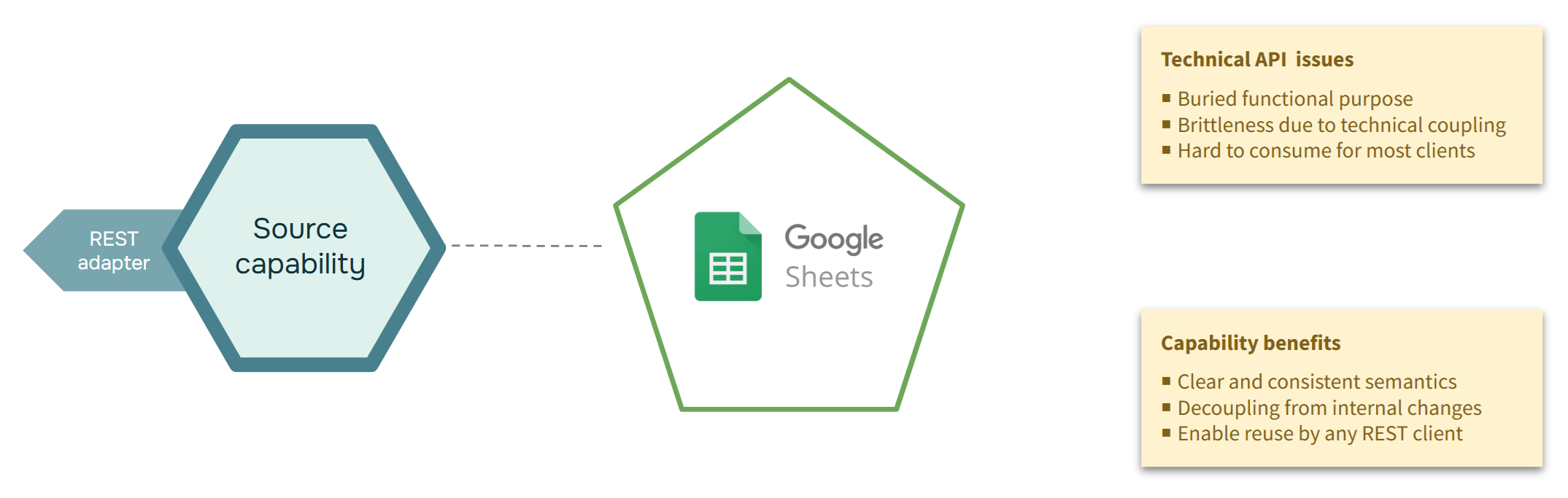
Wrap Google Sheets as a capability so spreadsheet rows become a reusable, domain-specific API for traditional clients and AI agents.
How the Naftiko Fleet achieves this technically:
- Consume the Google Sheets values endpoint in consumes.resources.operations, with templated spreadsheet_id and range path parameters plus API key injection through binds.
- Transform raw row arrays from $.values into named objects using positional JSONPath mappings such as $[0], $[1], and $[2] inside typed outputParameters — evaluated by the Ikanos runtime.
- Expose the normalized result through type: rest, type: mcp, or both, so one spreadsheet integration serves both application and agent use cases.
Key features
- Declarative Google Sheets API consumption
- Templated spreadsheet ID and A1 range parameters
- API key injection via externalized bind values
- Declarative row-to-object transformation
- Positional JSONPath mapping from array columns to named fields
- Typed JSON array exposure for downstream consumers
- Dual-channel exposure from one capability
- REST resource exposure for conventional clients
- MCP tool exposure for AI agents
5. Compose AI context
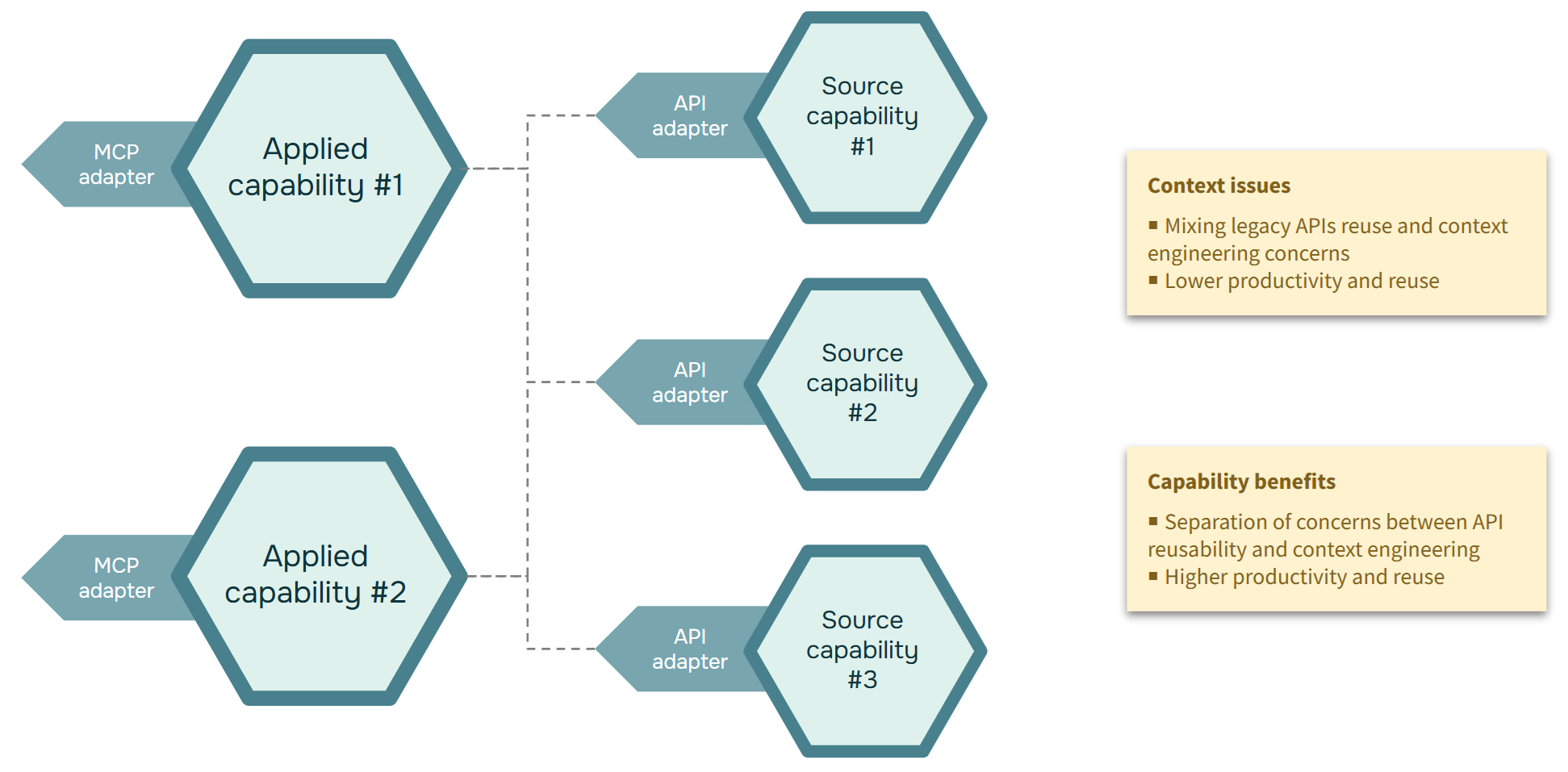
Combine data from multiple APIs into one capability to deliver richer, task-ready context to AI clients.
How the Naftiko Fleet achieves this technically:
- Register multiple consumed APIs with unique namespaces, then orchestrate cross-source calls using ordered steps in the Ikanos engine.
- Bridge calls through step mappings and per-step input injection, so outputs from one source feed inputs of the next.
- Return a single composed output model via mapped outputParameters, giving AI clients one coherent result.
Key features
- Declarative source HTTP adapter and target MCP adapter
- Support for multiple consumed adapters with unique namespaces
- Reuse consistent APIs and JSON payloads
- Multi-step orchestration with ordered steps
- Call steps to invoke consumed operations
- Lookup steps for in-memory data joining
- Step output bridging via
withandmappings - Composed output model from cross-source data
- Named orchestrated output parameters
- Nested objects and typed arrays
6. Rightsize a set of microservices
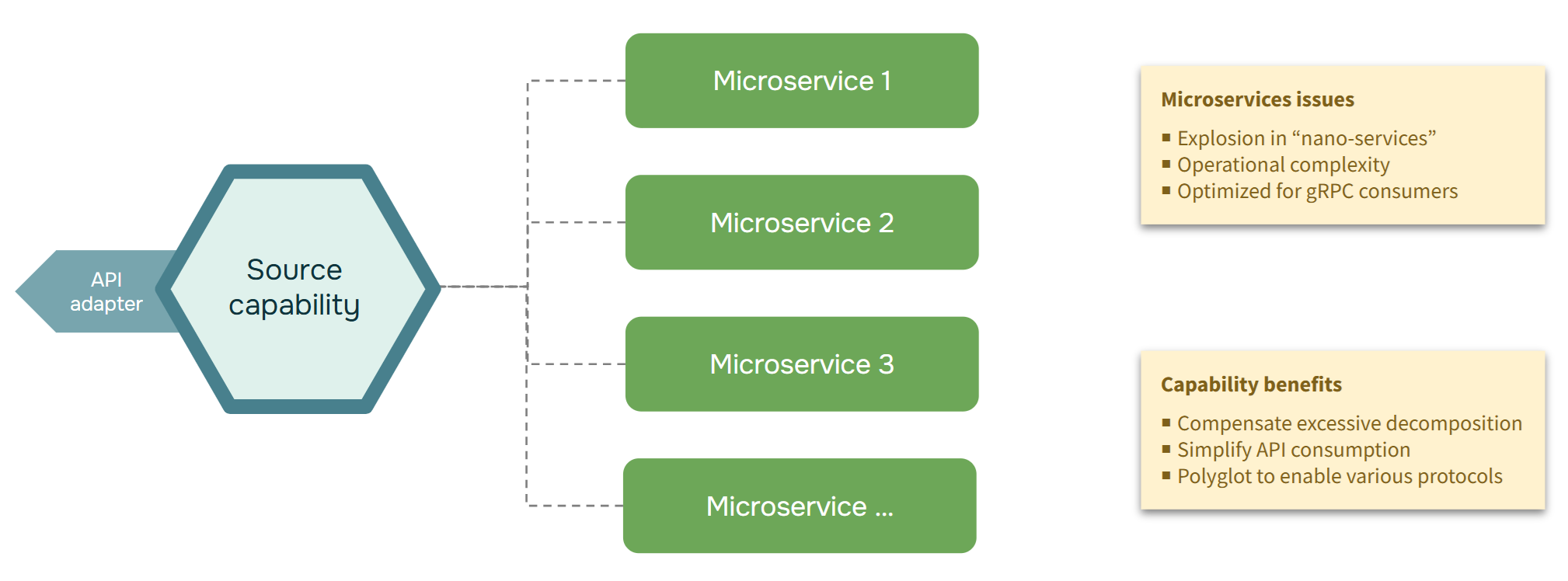
Create a simpler capability layer over many microservices to reduce client complexity and improve consistency.
How the Naftiko Fleet achieves this technically: - Aggregate multiple microservice endpoints under one exposed namespace and a small set of business-oriented resources/tools, served by the Ikanos engine. - Standardize auth/header behavior and parameter handling at capability level instead of duplicating logic in every client — with conventions enforced by Polychro rulesets. - Use orchestration and output shaping to hide service fragmentation and return consistent contracts.
Key features
- Declarative source HTTP adapter and target REST adapter
- Support for source APIs with JSON payloads
- Convert YAML, Protobuf, XML, Avro, and CSV payloads to JSON
- Support sequence of steps with calls
- Multiple consumed adapters per capability
- Namespace-scoped auth, headers, and base URI per adapter
- Unified parameter handling across microservices
- Input parameters in query, header, path, cookie, and body
- Regex pattern validation on string inputs
7. Rightsize a monolith API
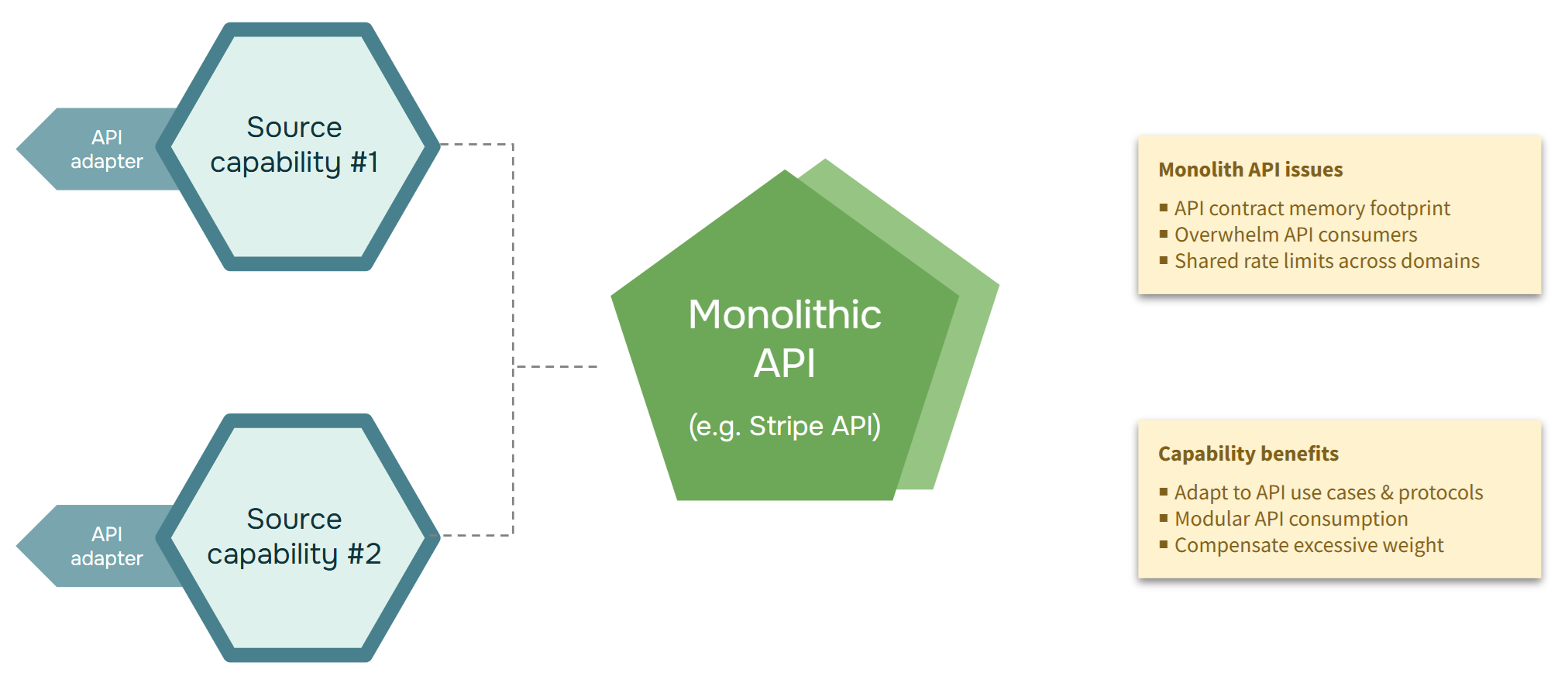
Extract focused capabilities from a broad monolith API so consumers get only what they need for each use case.
How the Naftiko Fleet achieves this technically:
- Select only required monolith operations in consumes and remap them to narrower exposed resources/tools.
- Use output filtering/mapping to publish smaller, purpose-built payloads for each consumer scenario — executed by the Ikanos runtime.
- Optionally forward selected routes with forward.targetNamespace to keep passthrough paths where full transformation is not needed.
Key features
- Selective operation exposure from a broad API
- Remap consumed operations to narrower exposed resources
- Output filtering via typed parameters and JSONPath mapping
- Forward proxy for pass-through routes
-
forward.targetNamespacefor direct routing - Trusted header forwarding for security
- Dual-channel exposure from one capability
- REST resource exposure for conventional clients
- MCP tool exposure for AI agents
8. Capability-driven context engineering
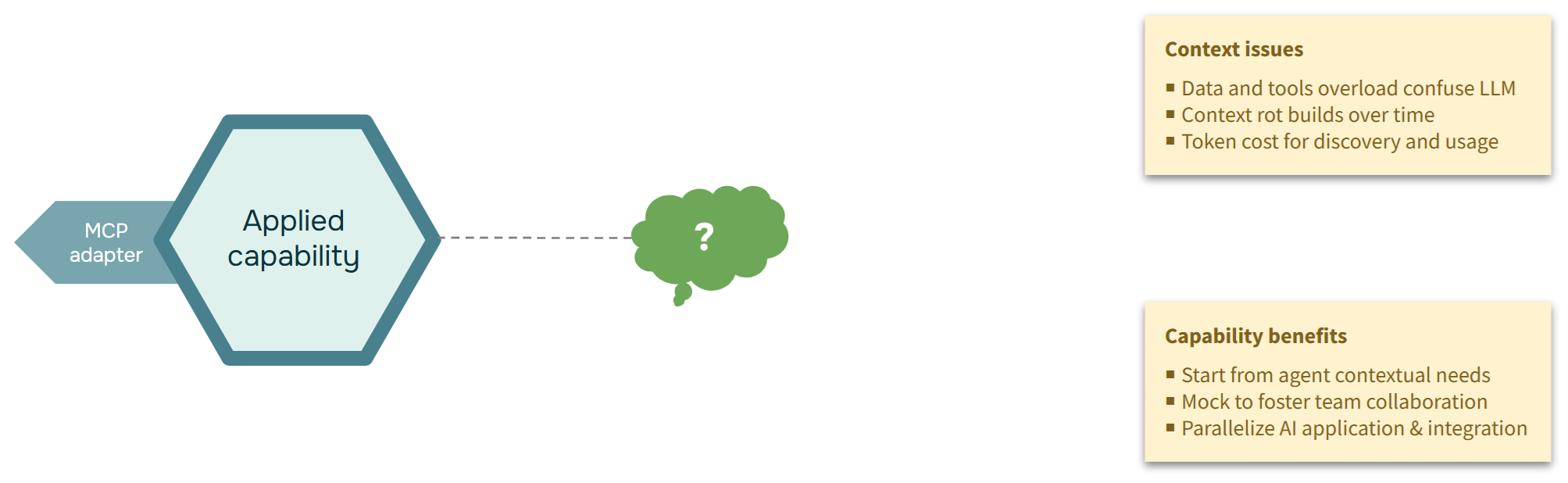
Design capabilities first for MCP clients, then map them to underlying APIs for a clean AI-native integration model.
How the Naftiko Fleet achieves this technically:
- Define type: mcp exposure with server-level description and tool-level contracts (name, description, input/output parameters) — authored with Crafter and validated by Polychro.
- Support MCP transports (http or stdio) through the Ikanos engine, so the same capability can run in remote server mode or local IDE/agent mode.
- Wire tools to one or many consumed operations via call or orchestrated steps, without changing upstream APIs.
Key features
- Declarative MCP server with tools, resources, and prompts
- Typed input parameters with descriptions for agent discovery
- Static file-backed resources with MIME types
- Prompt templates with argument placeholders
- Support for key MCP transport protocols
- MCP for Streaming HTTP (for remote MCP clients)
- MCP for Standard IO (for local MCP clients)
- Mock mode for MCP tools
- Static value outputs without consuming an API
- Dynamic mock values using Mustache templates from input parameters
- Multi-step orchestration wired to consumed operations
- Call and lookup steps with cross-step output bridging
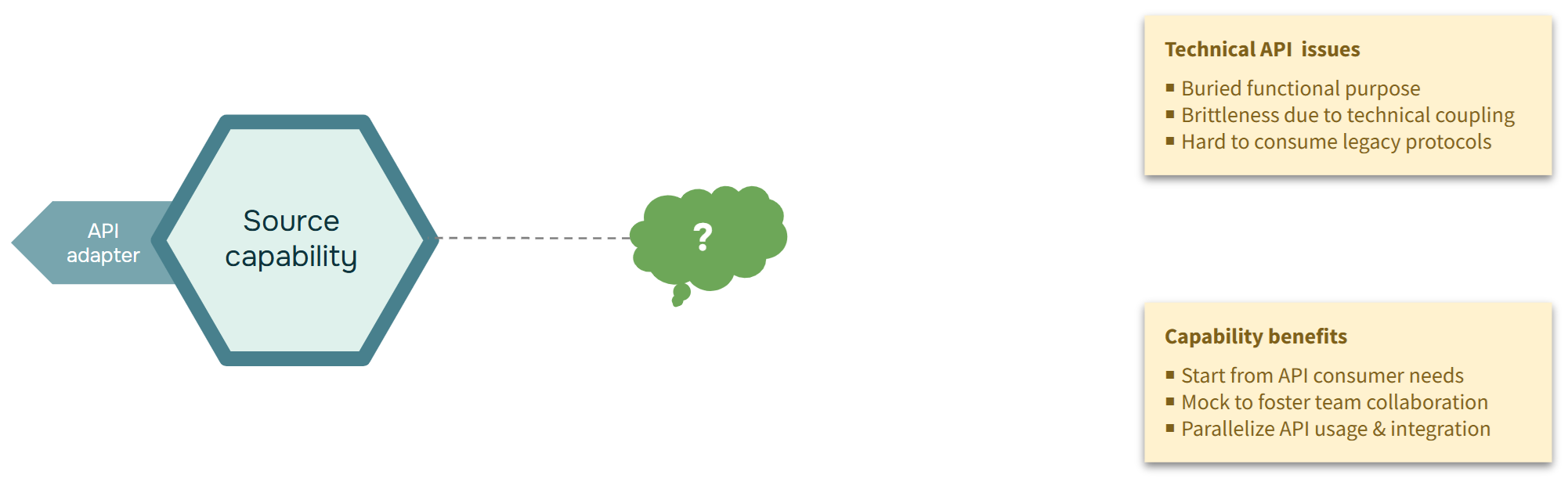
9. Capability-driven API reusability
Start from existing APIs and define reusable capabilities on top, so API investments can power new AI and app experiences.
How the Naftiko Fleet achieves this technically:
- Begin with consumed API declarations (baseUri, auth, resources, operations), then incrementally add exposed REST/MCP adapters served by the Ikanos engine.
- Reuse existing security and configuration using binds with file or runtime injection and injected variables (e.g., {{API_TOKEN}}).
- Add format-aware parsing and mapping (JSON, YAML, XML, CSV, TSV, PSV, Avro, Protobuf, HTML, Markdown support in the framework) to normalize diverse backends.
Key features
- Externalized secrets via
binds - Support for file, vault, GitHub secrets, K8s secrets, and runtime injection
- SCREAMING_SNAKE_CASE variable expressions
- Consumes import and reuse across capabilities
- Import by location with optional namespace aliasing
- Format-aware response parsing and normalization
- JSON, XML, YAML, CSV, Avro, and Protobuf to JSON conversion
- Multiple request body formats
- JSON, XML, form URL encoded, multipart form
- Incremental adapter addition (REST, MCP, or Skill)
- Skill server exposure with agent-compatible metadata
10. Interoperate with OpenAPI
Bridge existing OpenAPI ecosystems with Naftiko capabilities: import OAS documents to bootstrap consumption adapters, and export REST adapters as standard OpenAPI specifications.
How the Naftiko Fleet achieves this technically:
- Import an OpenAPI 3.0 or 3.1 document (or a Swagger 2.0 document, which is auto-converted) with ikanos import openapi, generating a ready-to-use consumes HTTP adapter with authentication, operations, input parameters, and output parameters pre-filled.
- Export a REST exposes adapter with ikanos export openapi, producing a standards-compliant OAS document that can be shared with API gateways, developer portals, and documentation tools.
- Use --adapter <namespace> to target a specific REST adapter when the capability exposes more than one.
Key features
- OpenAPI import into Ikanos
consumesadapter - Swagger 2.0 support (auto-converted to OAS 3.0)
- OAS 3.0 and 3.1 support
- Authentication mapping (bearer, basic, API key, digest)
- Automatic namespace derivation from API title
- Operation grouping by tag into separate resources
- Input parameter conversion (query, header, path, cookie, body)
- Output parameter conversion (object, array, scalar, allOf, oneOf)
- OpenAPI export from Ikanos REST
exposesadapter - OAS 3.0 and 3.1 output via
--spec-version - YAML and JSON output formats
- Multi-adapter selection with
--adapter - Security scheme generation from consumed authentication
- Round-trip fidelity
- Import → export preserves structure and semantics
11. Monitor and debug capabilities
Observe capability behavior in real time with built-in metrics, distributed traces, and health checks — configured entirely from the spec.
How the Naftiko Fleet achieves this technically:
- Add a type: control adapter in capability.exposes to expose a management plane with health, metrics, traces, and diagnostic endpoints on a dedicated port of the Ikanos engine.
- Configure capability.observability to enable OpenTelemetry-based distributed tracing and RED metrics (Rate, Errors, Duration) with configurable sampling and OTLP export.
- Scrape Prometheus-format metrics from the control port's /metrics endpoint and inspect recent traces via /traces — no additional infrastructure code required.
Key features
- Built-in control port with configurable endpoints
- Liveness and readiness health probes
- Prometheus metrics scrape endpoint
- Local trace inspection endpoint with ring buffer
- Runtime status and configuration endpoints
- Hot-reload and dry-run validation endpoints
- Log level control and SSE log streaming
- OpenTelemetry observability from the spec
- Distributed tracing with W3C and B3 propagation
- Configurable sampling rate
- OTLP exporter with Mustache-templated endpoint
- RED metrics: request duration, step duration, HTTP client duration, error count
- Spec-driven configuration — no code required
- Control port address, port, and authentication
- Per-endpoint enable/disable toggles
12. Transform data between API calls
Reshape, filter, or aggregate data between consumed API calls using inline script steps — without building a separate microservice or writing Java code.
How the Naftiko Fleet achieves this technically:
- Add type: script steps in orchestrated operations to transform data between call steps using JavaScript, Python, or Groovy, executed by the Ikanos engine.
- Scripts run in sandboxed environments (GraalVM for JS/Python, SecureASTCustomizer for Groovy) with no filesystem or network access.
- Previous step results are bound as variables; scripts assign to result to produce output for subsequent steps or mappings.
- Govern execution centrally via the Control Port's management.scripting block — set defaults, timeouts, statement limits, and allowed languages.
Key features
- Inline script steps in orchestrated operations
- JavaScript execution via GraalVM Truffle
- Python execution via GraalVM Truffle
- Groovy execution via GroovyShell
- Script dependencies (shared helpers, libraries)
-
withinjection for input parameter binding - Security and governance
- Sandboxed execution — no I/O, no network, no system access
- Configurable statement limits and timeouts
- Allowed languages restriction
- Control Port
/scriptingendpoint for runtime management - CLI
ikanos scriptingcommand for governance - Linting support
- Spectral rule
ikanos-script-defaults-requiredvalidates Control Port defaults